

In più, si tenga altresì presente che il mio interlocutore dei tempi conosceva tutta la (prima) serie animata quanto me, quindi scordatevi cappelli introduttivi del genere “che cos’è Gunslinger Girl”? Se non lo sapeste (e non sarebbe una colpa) e voleste intendere le righe che seguono (ma sarebbe una colpa?), potreste sempre dare una scorsa alla pagina di Wikipedia sul titolo in questione. In ogni caso, per l'intendimento plenario di molti riferimenti che seguiranno sarebbe necessario aver visto (e aver ben presente) la serie di cui si dice. Mi scuso con gli altri eventuali lettori.
Segue quanto segue.

Gunslinger Girl(s)
Dunque come
è noto, ho lavorato alla versione italiana, sia in qualità di
adattatore dei dialoghi che di direttore di doppiaggio. Ho
scelto personalmente i doppiatori, e in più sono stato responsabile
della completa direzione di produzione. Si è trattato di un bel po’ di
duro lavoro e, come si potrà immaginare, ho sentito una profonda
responsabilità di andare sempre più in profondità nell’opera
originale, per capirla appieno.

Per essere onesto, quando venni in contatto per la prima volta con Gunslinger Girl, d'acchito pensai semplicemente: “Ok, diciamo che se GunBuster ed Evangelion erano dei 'bishoujo to robotto anime', questo è un 'rori to teppou anime'...”. (Le espressioni giapponesi significano rispettivamente ‘anime di belle fanciulle e robot’ e ‘anime di lolite e pistole’. La prima definizione venne realmente usata dallo stesso regista Anno Hideaki per definire, tra il serio e l’autoironico, le sue due opere citate. N.d.T.) Pensavo a questo modo come per disprezzare l’opera. Ma mi sbagliavo. O anche, avevo ragione. Infatti, sia GunBuster sia Evangelion sono certamente dei ‘bishoujo to robotto anime’, ma ovviamente sono anche pieni di idee e momenti significativi. Lo stesso può dirsi per Gunslinger Girl, che è senz’altro un ‘rori to teppou anime’, ma ha altrettanto un più profondo livello di lettura. In questo senso, chiaramente, il primo punto è: “se si parla di un amore di bambina, quindi di un sentimento d’amore tanto puro e idealistico... vi è alcuna differenza dal condizionamento mentale?” L'autore non esista a mettere questo preciso dubbio sulle labbra di una delle ragazze, ovvero Triela.
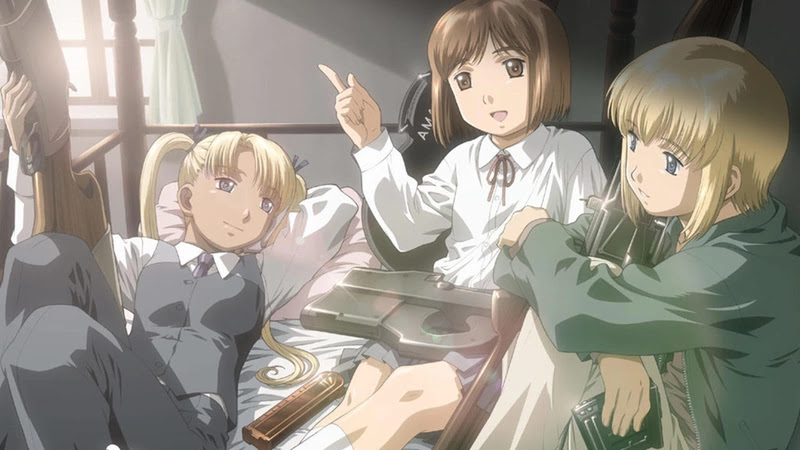

Per quanto riguarda la prima serie animata di Gunslinger Girl, quella su cui ho lavorato personalmente, il suo contenuto segue la primissima parte del manga, ma ne rielabora il materiale narrativo, dando più approfondimento alla storia di Elsa DeSica & Lauro. Inoltre, le musiche sono perfette e aggiungono grande atmosfera alla storia. Il risultato sembra riuscito, e non si può non aggiungere che il regista del caso, ovvero Asaka Morio, aveva di certo già una certa esperienza con i sentimenti romantici giovanili femminili dai tempi di una certa cattura-carte di nome Kinomoto Sakura. La seconda serie, sottotitolata Il Teatrino, può sembrare di livello qualitativo inferiore, ma in realtà è il felice risultato di un tentativo autoriale di raggiungere una maggiore aderenza grafica allo stile di disegno del manga originale.

Ad ogni modo, che si tratti dei primi volumi del manga o della serie animata, la prima parte della storia ha ovviamente il compito di presentare tutti gli interpreti delle vicende, e i loro vicendevoli rapporti. Ma addentrandosi nella logica di questi ultimi, si vede bene che ogni coppia è in qualche modo bilanciata per rappresentare un particolare stato mentale di 'bambina innamorata’.

La protagonista Henrietta incarna l'archetipo dell’amore positivo, che ha speranza di essere ricambiato. Henrietta può sembrare semplice, ma non lo è. Dietro al suo candido sorriso è presente una onesta consapevolezza della propria situazione. Ma lei ha l’amore, quindi può sopravvivere persino a quella. Nulla può turbare una ragazza che è innamorata e ha la speranza di essere amata. Con Henrietta ecco Giosè, che non è un personaggio semplice. Non è il solito ‘cavaliere buono’. Lui ha ombre oscure in sé, collegate alla morte della sua vera sorella, Enrica (ovviamente Henrietta suona come Enrica-chan [Enrichetta, N.d.T.]).
Rico è l'incarnazione dell’amore per la vita, in quanto tale. Si può immaginare una vita senza alcuna possibilità di muoversi, o di fare qualsiasi cosa, sin dalla nascita? Rico è felice di avere una vera vita, e prova una grande gratitudine verso Gian, che gliel’ha concessa. Io penso che in realtà lo ami, a suo modo. Per contro, Gian può sembrare spietato nei confronti di Rico, ma questo perché lui deve ancora ‘ritrovare’ i suoi sentimenti amorosi dopo la perdita di sua sorella Enrica (e non solo). Si noti questo: il maschile di ‘Enrica’ è ‘Enrico’, e penso che il nome ‘Rico’ sia derivato proprio da lì (Rico non esiste realmente come nome italiano). Quindi fondamentalmente sia Giosè che Gian hanno subìto la stessa ferita, la perdita dell’amata sorella minore. Ma mentre questo ha reso Giosè ipersensibile, portandolo a ricreare un’ideale immagine/avatar di sua sorella (Henrietta), Gian è diventato totalmente freddo, persino ‘distruggendo’ l’immagine di sua sorella (come facendola rivivere in un maschio: Rico). Sono piuttosto sicuro che Gian scoprirà presto che ama Rico, solo che ancora non lo sa. Sarà un grande shock per Gian. Questa è la mia coppia preferita.
Triela, ovviamente, è la più ‘adulta’ delle cinque ragazzette protagoniste. Lei combacia alla perfezione con Hilscher, perché entrambi sono semplicemente ‘persone incapaci di esprimere i propri sentimenti’. Loro due sono proprio identici. Eventualmente lo scopriranno. Con questo, il rapporto tra Triela e Hilscher è anche il più ‘normale’ di tutte le ‘coppie di fratelli’, perché è fatto di discomunicazione e fraintendimenti emotivi. Le persone che non riescono conoscere onestamente i propri stessi sentimenti difficilmente possono dialogare con chi amano, perché non riescono ad ammettere a loro stessi la loro stessa realtà e dipendenza emotiva. Ma proprio in questo Hilscher e Triela possono davvero completarsi a vicenda, imparando l’uno dall’altro la dimensione del proprio affetto.
Claes è il simbolo dell’amore di una figlia per il padre, la cui figura è incarnata nel suo gestore Labaro. Per di più, un padre, un educatore, purtroppo ben presto morto. Così Claes è il tipo di ragazza che è dovuta crescere in fretta, è diventata fredda e solitaria, e deve vivere per sé stessa solo per ‘onorare’ la memoria del suo mentore. Un dato significativo che viene espresso da Aida Yuu in merito a Claes è la non-ricondizionabilità delle bambine. Con spietatezza Aida Yuu ci ricorda che il primo amore è l’unico che possa avere la speranza di potersi dire il solo, ragion per cui resta poi quello che "non si scorda mai". Curiosamente, pressoché tutti concordano su questo semplice detto popolare, ma la sua altrettanto semplice ragione sembra essere dimenticata pressoché da tutti. Ma nonostante i tentativi di rimozione mnemonica, Claes non può dimenticare del tutto il suo pur defunto referente maschile, ed è quindi ‘condannata’ alla solitudine reale di un amore che è anche tipicamente vedovile.
Angelica... che si può dire di lei? Il primissimo esemplare di bambina con "corpo protesico" (come in Koukaku Kidoutai!) è piuttosto simile a Henrietta, solo persino più giovane. E in più, in quanto prototipo lei soffre di perdite di memoria. Anche se molto drammatico, lei è il personaggio più ‘strumentale’ del mucchio (infatti nel manga è anche la prima a morire). Penso che Angelica sia strumentale all’idea de ‘il cambiamento di un uomo’ in relazione al suo padrone Marco. Marco viene semplicemente distrutto dal senso di perdita del suo affetto per Angelica, che ha continue perdite di memoria. Come può esistere un affetto senza memoria? Che senso ha l’affetto dinanzi alla caducità dell’essere umano? Credo che ogni vero innamorato, inconsciamente, desideri di non sopravvivere alla persona che ama, ma di morire prima di quella. Ma ancora, il significato di Angelica è lo stesso di quello di Henrietta: una bambina può essere felice fintanto che ha il suo amore, perché è ancora pura. La ‘prospettiva amorosa’ è ancora sufficiente per lei, ovvero esaurisce tutta la sua ‘prospettiva di vita’, che si risolve nella prima (il che, ovviamente, non potrebbe certo dirsi per una donna adulta), infatti alla fine dell’anime si può vedere Angelica morire con un sorriso di felicità sul viso, perché alla fine ha recuperato il proprio amore da Marco. Si noti dunque che è proprio Henrietta empatizzare più di tutti con Angelica, come a evidenziare ancor più la loro affinità di status mentale. E si noti anche che è la stessa Henriteta a ‘spiegare’ i sentimenti di angelica a Marco: certe volte una bambina può capirne di sentimenti femminili molto più di un uomo, anche adulto.
Benché sia imbarazzante, devo
proprio ammettere che mi commuovo sempre quando vedo la scena finale con la
morte di Angelica sotto la pioggia di stelle cadenti, e le altre ragazze
che cantano l’Inno alla Gioia. Credo che questa scena, assente nel manga e realizzata per dare un finale alla prima serie animata, sia molto influenzata da Evangelion. L’ambientazione per le ragazze è identica a quello della fine dell’episodio 11 di Eva (SeishiShita Yami no Naka de - The Day Tokyo-3 Stood Still).
Si può notare che Triela e Asuka recitano un ruolo molto simile
parlando della società umana e della luce naturale/artificiale. E in
più, anche l’uso dell’Inno alla Gioia (usato anche in Eva per la scena finale di Nagisa Kaworu) può essere un riferimento a Evangelion. In un certo senso, la morte di Angelica diventa come la morte di Nagisa Kaworu.
Infine, Elsa e Lauro. Loro sono proprio al perfetto opposto di Henrietta e Giosè. Se Henrietta è il simbolo di un amore corrisposto, Elsa è il simbolo di un amore disperato. Del resto, Lauro è l’opposto di Giosè: se Giosè è un nevrotico che cerca di prendersi la piena responsabilità dei suoi atti, Lauro è una persona sensibile che cerca di evitare quei sentimenti che sa che non potrebbe sostenere. Curiosamente, si direbbe che tra i due quello ‘normale’ sia certamente Lauro. Tuttavia, fino a che Elsa non ha incrociato col suo sguardo il sentimento tra Henrietta e Giosè, un amore speranzoso, poteva illudersi che la sua devozione ‘a senso unico’ per Lauro fosse sufficiente come sua ragion d’essere. Ma specchiandosi nel suo opposto, ovvero Henrietta, Elsa comprende l’insensatezza del suo sentimento, e quindi della sua esistenza. La fine dell’episodio 11 è davvero un capolavoro, con il montaggio ana-logico degli atti Henrietta ed Elsa. Davvero i quattro ‘cardini’ Henrietta-Giosè-Elsa-Lauro tracciano uno schema perfetto per mostrare i sentimenti e le emozioni umane. La scena in cui Elsa dichiara a Lauro quanto importante sia per lei il nome che lui le ha dato (o come lei dice: ‘donato’) è davvero toccante. “Daiji na mono desu! Zettai wasuremasen!” ("È una cosa preziosa! Non la dimenticherò assolutamente!" N.d.T.) – stavo tremando per le profonde emozioni.
Elsa ci ricorda che persino una bambina innamorata deve essere ricambiata nel suo amore per avere una possibilità di essere felice. L’amore disperato può dissimularsi in devozione estrema, ma trattandosi di una devozione senza scopo risulta sempre in disperazione. La consacrazione a un ‘dio vivente’ del tutto insensibile all’esistenza stessa della sua fedele diviene autodistruzione. Ancora una volta, è ben significativo che Henrietta possa comprendere con facilità il sentimento di omicidio-suicidio d’amore di Elsa, del tutto incomprensibile per gli adulti presenti alla spiegazione della bambina. Dunque su tutto e su tutti trionfa questa idea dell’amore giovanile, puro, totalizzante, e quindi estremo e radicale. La cosa più radicale da fare è amare, ma assumendosi la responsabilità dell’amare, la responsabilità dell’essere amati. Questi sono temi che mi sono particolarmente cari, perché io per primo ritengo che la ‘deresponsabilizzazione sentimentale’ sia una delle più grandi piaghe del nostro tempo. La storia di Gunslinger Girl, al contrario, si incentra sulla profondità di sentimenti imperituri quali il desiderio di fedeltà, di dedicazione a una persona, o a una causa, o a una vendetta. Tutti archetipi che al giorno d'oggi, nella società dei consumi e dell'appagamento mercenario di ogni falso bisogno, sembrano troppo dimenticati, per citare una certa volpe del deserto.
Now back to the future: dunque, qui si concludeva il testo originale. Quindi, dopo così tanti anni, cosa aggiungere a chiosa del tutto?
Beh,
direi in primis che è davvero mirabile che un così importante, incisivo
significato sia stato infuso in quella che, in fondo, resta comunque
una narrativa del tutto ‘leggera’ e ‘commerciale’ (per usare termini a
me assai sgraditi, ma giochiamo a capirci, suvvia). Chi ha letto il manga fino alla fine, perché come dicevo si tratta di un'opera ormai conclusa e completa, saprà anche che fui un profeta fin troppo veggente sui cardini e sugli sviluppi della narrazione e dei personaggi.
In secundis, quando si parla della responsabilità del sentimento, mi viene sempre da ripensare al fatto che quel bel libro che si intitola Il Principino (per i meno perspicaci: sarebbe la traduzione italiana corretta de Le Petit Prince) sembra davvero essere ben compreso in Giappone, mentre qui in Italia – per non dire in tutto l’occidente – la lettura che se ne fa è del tutto buonista, favolistica e a mio parere persino antitetica rispetto al reale contenuto dell’opera. Varranno a scopo esplicativo poche righe di citazione. I grassetti sono dell'umile Vostro:
Le petit prince s’en fut revoir les roses:
– Vous n’êtes pas du tout semblables à ma rose, vous n’êtes rien encore, leur dit-il. Personne ne vous a apprivoisé et vous n’avez apprivoisé personne. Vous êtes comme était mon renard. Ce n’était qu’un renard semblable à cent mille autres. Mais j’en ai fait mon ami, et il est maintenant unique au monde.
Et les roses étaient bien gênées.
Et il revint vers le renard
– Adieu, dit-il...
–
Adieu, dit le renard. Voici mon secret. Il est très simple: on ne voit
bien qu’avec le cœur. L’essentiel est invisible pour les yeux.
– L’essentiel est invisible pour les yeux, répéta le petit prince, afin de se souvenir.
– C’est le temps que tu as perdu pour ta rose qui fait ta rose si importante.
– C’est le temps que j’ai perdu pour ma rose... fit le petit prince, afin de se souvenir.
– Les hommes ont oublié cette vérité, dit le renard. Mais tu ne dois pas l’oublier. Tu deviens responsable pour toujours de ce que tu as apprivoisé. Tu es responsable de ta rose...
– Je suis responsable de ma rose... répéta le petit prince, afin de se souvenir.


Chissà, forse il Principino poteva capirlo perché era ancora un bambino, cioè era ancora puro, proprio come lo sono Henrietta, o Elsa DeSica. Infatti, alla fine il Principino sceglie la morte, e si suicida per espirare la colpa dell’abbandono della sua Rosa. È una lezione molto triste, ma altrettanto valida. Ed è davvero molto più triste notare come anche le lezioni migliori risultino del tutto vane, semplicemente perché non vengono intese. Del resto, suppongo che non ci sia peggior stupido di chi non vuol capire.
Chissà se scommettere sempre sulla minoranza dei coraggiosi che se la sentono di rischiare davvero, e comprendere anche ciò che potrebbe metterli in discussione, può dimostrarsi sensato sul lungo termine.
Chissà.
Il link conduce a un articolo speciale giapponese pubblicato in prossimità della fine del manga.
Le pagine 2 e 3 contengono un'intervista all'autore. Il titolo del tutto è invece sempre la catchcopy della serie, ovvero: "Ad essere stato dato alla ragazzina, è un grosso fucile e una piccola felicità"
(nota: 小さな幸せ [chiisana shiawase], erroneamente tradotto in italiano come Poca Felicità, è anche il titolo dell'Image Album dedicato alla prima serie animata.)
Poi:
相田裕の「GUNSLINGER GIRL」"改造"と"再生"の10年 展
Qui si tratta di una mostra che si tenne alla Meiji University dopo la conclusione del manga.
Il titolo è: "Esposizione "GUNSLINGER GIRL' di Aida Yuu, dieci anni di "modificazione" e "rinascita".
(nota: "改造" e "再生" [kaizou e saisei] sono concetti chiave, e anche storicizzati, nel linguaggio giapponese che riferisce a cyborg, cloni e compagnia bella, spesso riferiti come kaizou-ningen [esseri umani modificati] già nella saga di Kamen Rideri].
Ah, volevo anche ricordare a tutti che il protagonista maschile, responsabile dell'androide Henrietta, si chiama Gioseffo. La cosa è resa quanto più esplicita nel finale del manga, quando vengono listati i caduti della battaglia finale. Non è Giuseppe, non è Giusè, e men che meno José. Al contrario, "Giosè è sempre stato il diminutivo di Gioseffo, e il nome Gioseffo viene probabilmente da quello di Gioseffo Zarlino, che fu un compositore italiano del 1500, il cui primo allievo si chiamava poi Giovanni Croce. Avevo trovato tutti i fili. Ma soprattutto, se andate a vedere la prima traccia di 'Poca Felicità', il succitato image album giapponese di Gunslinger Girl, ebbene la prima traccia si intitola 'Lui si chiama [kare no na wa]', e inizia con Nanri Yuuka [la doppiatrice originale di Henrietta] che canta IN ITALIANO: "Lui... si chiama... Gioseffo... Gioseffo."
Dico davvero, eh! Fa quasi ridire. Non ci credete? Ecco a voi!
Infine, ecco a voi una traduzione in inglese di un'intervista all'autore apparsa originariamente proprio in italiano (grassetti miei):
Interviewer: Let’s get started with the standard question, which in your case is definitely inevitable, because there is very little information about you on the internet: some personal data.
Aida: My name is Yu Aida and I was born on 8th November 1977 in Tochigi Prefecture, not far from Tokyo.
I: “Flowers”, published in 2001, and “Gunslinger Girl” are your two first works as a mangaka. What did you do before?
A: I attended university, where I was in the “club for studying manga[1]” and in the meantime I drew for some fanzines. I always loved manga, but after the degree I started working for a videogame company as an illustrator. The opportunity to become a professional mangaka came later, when I started to serialize “Gunslinger Girl” in a magazine.
I: The first time I saw “Gunslinger Girl” was in the 2001. I remember that the person in charge of a publishing house which we had close connections to told me to come to him because he had something to show me. When I arrived he was all excited and he showed me some photocopies of the illustrations of “Gunslinger Girl”. It was slightly different from the series you published later, but it was possible to see some common points, like the choice of Italy as the setting and the idea of using little girls with biomechanical limbs as killers. Some years later I was surprised to see that manga published by an editor so important as MediaWorks!
A: You probably saw the illustrations I drew for a fanzine. It was a short story of three chapters about 16 pages each. I published it between 1998 and 2000, while I was still attending the university. Many “experts” who read it were favorable surprised by it and so shortly later I begin to serialize it in “Dengeki Daio”, a monthly magazine owned by MediaWorks. Since the publication on a periodical requires a more developed plot than a short story I decided to revise and enrich all the plot, even if the two elements you pointed before remained practically the same since the fanzine.
I: A novice who had to work on a monthly series: it must have been a lot of work! Had you already gotten any assistants at the time?
A: No, the first chapters were drawn entirely by me, and they required superhuman effort…!
I: I didn’t expect you were a member of a “club for studying manga” and that you drew for some fanzines. I’m saying this because in your drawing style is difficult to find influences from any particular artists; so I always thought of you as a videogame illustrator become mangaka “by chance”, rather than a mangaka who started his career as a videogame illustrator.
A: Truth is I’ve been influenced by many authors and many works. For instance, I think “Gunslinger Girl” owes a lot to Masami Yuki’s “Mobile Police Patlabor”, Ken’ichi Sonoda’s “Gunsmith Cats”, and Naoki Urasawa’s “Master Keaton” and “Pineapple Army”. They all are authors that I love and respect, even if I don’t really have a favorite manga or author.
I also believe that many readers could misunderstand this work at the beginning: being published in a magazine which mainly contains comic or videogame related manga which are all about seductive girls, it’s often confused for a manga of that kind, especially because all the main characters are girls. Truth is that this has nothing to do with these categories: my narrative choices are very similar to the seinen manga like Urusawa’s ones, while the psychological introspection in my characters is often comparable to the stylistic features of the shoujo manga.I: From the reading of “Gunslinger Girl” we can notice your deep knowledge of classic music, literature, cinema…
A: During my academic years I was attending the Faculty of History, with a major degree[3] in western history, so I’ll say that I’ve a general smattering on all western cultures. But I’ll not say that it’s a “deep knowledge”: it’s more appropriate to say “vast, but shallow knowledge”, of a standard academic level.
About movies, as you rightly observed, they are one of my main sources of inspiration, which have provided me many decisive impulses in my creative work.I: Many mangaka, especially the ones of the “first generation” like Osamu Tezuka, always affirmed that they wanted to become movie directors instead, but due to Japan’s straitened circumstances during the post-war period they had to put their ideas on the paper instead of the film…
A: That’s right. Still now in Japan, due to budget reasons, it’s impossible to realize movies that can compete against the Hollywood ones. Me too, if I had the means and possibilities, I’d like to direct movies rather than drawing manga. But manga are still a kind of movie, with the fundamental difference that in manga there is only one person who is director, producer and “actor” at the same time. This could be an advantage, because it lets you have control on every production stage, while huge projects like a movie require efforts from hundreds of people and the skill to co-ordinate the staff and the cast, plus the need to accept every small compromise required by a team work. On the other hand, it’s the same for anime…
I: Are there some movies that you particularly love?
A: I’d have to make too long a list! I’d say that I generally prefer psychological introspection movies rather than action ones.
I: Even the “Bittersweet Fools” video game, which was published before “Gunslinger Girl”, is set in Italy, more precisely in Florence. From what did you develop this love for so distant a country?
A: If we want to be precise, the fanzine version of “Gunslinger Girl” is my first work set in Italy; then there is “Bittersweet Fools” and lastly the “Gunslinger Girl” series. I believe that one of the first reasons that drove me to choose Italy as a setting for my stories is that manga set in your country are extremely rare in Japan.
During the ’90s there were many manga which portrayed America, England or other English-speaking countries. There were also a few about Germany or German culture. I chose Italy to do something different from what was already available.
And what was just a pictorial excuse in the fanzine version of “Gunslinger Girl” has successively become a deep personal interest for Italy during the making of “Bittersweet Fools”. I remember that, when we decided to set it in Florence, I went to search some documentation about the city and I found a sort of tourist guide which contained a small poster of the Arno’s view where it crosses the city.
It fascinated me as soon as I saw it and in that moment the irresistible desire to visit and know those places better was born in me. Still today, even if I have the chance to visit many Italian cities, Florence is still one of my favorite destinations.I: So did you not visit Italy for the first time until after you painted it in the fanzine version of “Gunslinger Girl” and in “Bittersweet Fools”?
A: That’s right. The Italy which appears in those two works is just a result of my imagination and of a wide iconographic stock which I referred to.
I: I thought you visited Italy many times, because in your manga there are cities like Taormina or Montepulciano which are definitely famous, but they aren’t the typical destinations of the Japanese tourism.
A: You see, “Gunslinger Girl” is a work of fiction, but (or maybe because of that) I’ve been very careful to draw the most possible realistic settings, picturing aspects from the Italian everyday life that are not necessary linked to the postcard images of the big Art Cities. Of course all the foreign tourists know them and they can easily identify them, and this helps a mangaka a lot because you can evoke a particular atmosphere just drawing a monument or a landscape. But the tourist destinations don’t represent the entirety of the Italian reality. It’s necessary to maintain a realistic stroke because “Gunslinger Girl” is a work of fiction and you can’t let it became too unlikely to eyes of the the readers.
For that reason I often wanted to go to Italy and to directly collect information. So far I’ve had the possibility to go there three times and whenever I’m drawing “Gunslinger Girl” in my studio in Japan I often dream how easy and satisfying it would be to live and to draw there.I: About the realism, you’re very accurate even when you draw cars, mechanical objects and weapons. A personal passion?
A: We can tell that it’s the result of a general interest that we men have for this kind of things. To tell the truth I don’t have a particular passion, or at least not more than anyone else of my age. But I’m interested in the industrial design and in the continuous pursual of the union between beauty and functionality which is characteristic of every Italian designer. Both cars and weapons of your country share an incomparable elegance, esthetical beauty, and usability, and this is something really fascinating.
I: You defined “Gunslinger Girl” as a fictional story with a lot of realistic components without which the manga would become unbelievable. I think this is not restricted to just the graphical aspect of the series, but also to other aspects like the references to the North autonomist movements and the conflict with the Rome government, even if in the manga these aspects are very exaggerated compared with reality…
A: The girls in “Gunslinger Girl” belong to a killer government association that deals with “dirty” works and particularly with anti-terrorism activities, which, if carried out in the sunlight, would be condemned by the public opinion and by the organizations for the defense of human rights. When we speak about terrorism, especially in Japan, lately we think of the Islamic one: when I went to publish “Gunslinger Girl” in a magazine there was the attack on the Twin Towers. Since then, in stories and in manga, “terrorism” became a synonym for “Islamic terrorism”.
As I already said, I hate to tell stories similar to the ones already written, so I decided to search for different ideas, more intrinsic to the European and Italian reality. It was then that I bumped into the anti-globalization theme, into the diffusion of far right ideology in a wide part of Europe during the 90’s and into the studies about the red and black[4] terrorism in Italy during “the Years of Lead[5]”.
I remember a book about the federalism and the autonomist movements of North Italy, and those topics fascinated me because they gave me the idea to develop some very radical and original ideas. After I made them extreme, they became the ideological framework for those terrorist groups that I chose to be the “enemies” of my main characters. Also, from my external point of view, I noticed a curious contradiction between the European unity in Italy and the presence of some centrifugal forces which tended to break up the local groups. The same topics of the racism toward and the marginalization of immigrants are difficult to understand for a Japanese like me, who imagines Europe like a puzzle of different countries that are trying to forget their differences and their previous conflicts to forge a new socio-political organization.I: In the manga, the nationalists are also called “the Five Republics Faction”. Where did you get this name?
A: Right from the book I was talking about. Between a lot of theses there was one about the constitution of five independent republics: North, Centre, South, Sicily and Sardinia. The name derives right from this concept, even if the terroristic organization of the “Five Republics” as it appears in the manga hasn’t got anything in common with the Italian federalists. I don’t know how an Italian would react while reading this manga, because I’d never have imagined that it’d be translated and published in Italy!
I: A very direct question: at the end of your studies, your travels and your researches, what opinion do you have of Italy?
A: That it’s a country which gives extreme importance to personality and to originality. Japan obviously has its culture, but if you look closely you’ll find that it has been heavily influenced by other eastern and western civilizations.
On the contrary, Italy boasts an highly autonomous and original culture. I think it’s one of the aspects that fascinates many of us Japanese people.I: The subject of a child fighter with a mechanical body has already been developed in the past, for instance in Go Nagai’s “Cutie Honey”, but with a total different outcome. “Gunslinger Girl” is maybe the first manga to depict with so much delicacy and depth the feelings of the girls transformed into machines. At a structural level, we can notice that you alternate action episodes and introspective ones, as if you were trying to picture the feelings of the “marionettes”, but at the same time you were conscious of the need to keep alive the interest of the readers with more lively scenes. Should the existence of so accurate a structure make us suppose that you already know how you’ll develop the story and how you’ll end it?
A: The main topic of “Gunslinger Girl” is the representation of the personalities and the sufferings of these little girls with a mechanical body. As a “plus” I added the description of very delicate and complex human relationships and some narrative elements so that they can form in the mind of the reader the illusion of a realistic and plausible story. All these topics merged into an unicuum in a very spontaneous and natural way; this is something that, as an author, made me very proud. From the beginning I had already in mind how “Gunslinger Girl” would end, but with the passage of time I added and developed various topics and stories which “averted” the ending. But now the story is coming to a climax and soon the moment to put the basis for the ending that I have had in mind for years will arrive. Probably the story will take up about ten/twelve volumes.
I: Be honest, did you expect this success from your first work?
A: No, absolutely not, even if I were aware that it was an interesting subject that could fascinate a large slice of readers.
I: “Gunslinger Girl” suffered a peculiar destiny in Italy: the first edition of the manga was interrupted after two volumes, the anime even after the first episode. Despite all these problems, the Italian fans are many and very warm. What do you feel about coming to know them in person during some convention or meeting, maybe during another one of your “study visits” in Italy?
A: It’d be an extraordinary pleasure! I’m a Japanese author who draws for the readers of his country: it makes me curious to know how my work would be welcomed in Italy, where it’s set, and it would be very nice to directly hear the opinions of my readers.
I: One last question: what could you tell us about the new anime of “Gunslinger Girl”?
A: In Japan, it will be aired on a local network starting January 7, and its title will be “Gunslinger Girl – Il Teatrino[6]”. It will be a TV adaption of the third through the fifth volumes, the ones where Pinocchio appears. The main difference compared with the first series is that for this one I’ll be in charge even of the screenplay and the general supervision. Also the entire staff and the production company have changed: the production has been entrusted to Artland studio and the director will be Hiroshi Ishidori. For the screenplay, I’ll be helped by a pro – Tatsuhiko Urahata.
It’s my first time working directly on the production of an anime and I hope that all the public will appreciate the outcome![1] I think it’s something like the club of “Genshiken”. I don’t know how to translate it though. The Italian translation is probably wrong anyway, but I think you get the idea.
[2] He drew “Bittersweet Fools”, an hentai game quite similar to Gunslinger Girl. It will be cited later anyway.
[3] I can’t even start to explain what a mess the Italian university system is. I suppose there is not something like what I translated here in Japan (and probably even USA and UK), but I can’t do better than this.
[4] The “red terrorism” is the left-wing terrorism. The “black terrorism” is the right-wing terrorism. I don’t know if it’s an universal concept so I’m pointing it out.
[5] “The Years of Lead” are an historical period between 1968 and the late ‘70s where there were a lot of terroristic attacks, especially by a left-wing autonomist movement called “Red Brigades”.
[6] Il Teatrino is the place where marionettes stand during a play.

Nessun commento:
Posta un commento